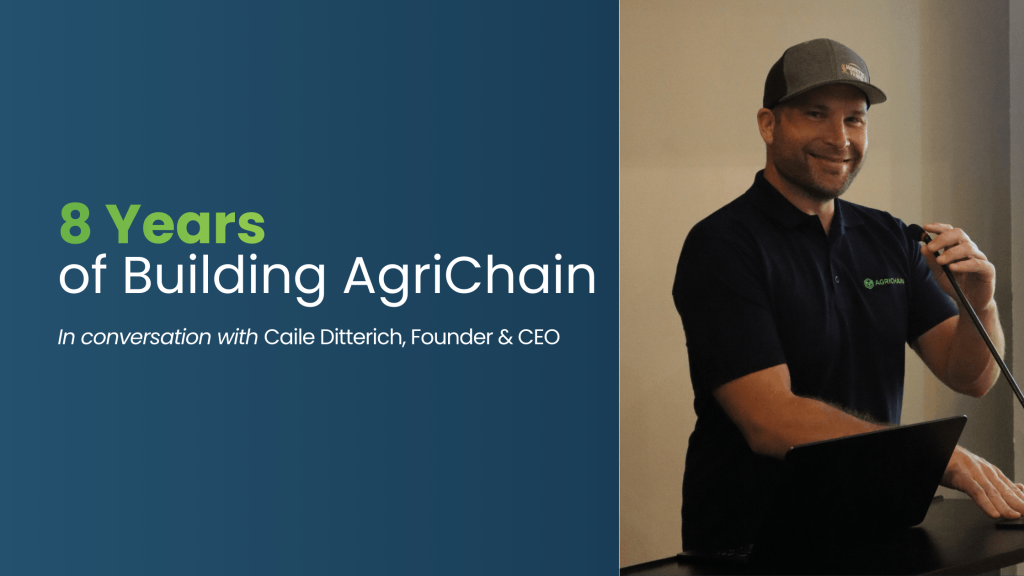
As AgriChain celebrates eight years of building digital infrastructure for agriculture, we sat down with founder and CEO Caile Ditterich to reflect on the journey so far.
From growing up on a farm in Northern Victoria to identifying critical gaps in grain supply chains, Caile shares the moments that shaped AgriChain and the challenges facing agriculture today.
Where It All Started
What drew you to agriculture in the first place?
My grandfather was a farmer in Northern Victoria, Australia, and I spent countless hours working with stock, growing grain, and fixing old machinery. I loved everything about the farming side of things, and naturally, the passion for agriculture followed.
When did you first realise something in the industry was broken?
I was working at GrainCorp at the time, which I really enjoyed, but I saw the inevitable writing on the wall as more and more farmers put in their own storage and silo bags. I could see the bigger and better farmers disengaging with our storage business, which created a need in the market for a product to help them manage their contracts and inventory.
What problem in agriculture bothered you the most?
We have come such a long way with respect to how we grow crops. Investment in productivity has been phenomenal, and we are seeing such massive gains in this area now. But the one area that we have not improved on as an industry is managing our data supply chain.
Our grain supply chains have become more dynamic and more complex over time and, in effect, in Australia, we have really dropped the ball in respect to how we manage supply chains.
What were people overlooking in this industry?
There is one main thing that we forget as an industry, and one people choose to ignore. The main thing we forget is that the level of data flow and the standard that is set across the industry affects everyone.
The ability to get delivery data back to a farmer, a trader, and a freight provider, and what is deemed acceptable, determines how fast money flows from the farmer to the trader to the freight provider and everything in between. The efficiencies related to logistics, deliveries, and associated processes affect everyone, and it’s an area that has just not progressed.
The second one is farmer-related. Good farmers are great at growing grain. There is a known recipe, and they follow it to the letter of the law. What separates them from great farmers is that they elect to not ignore their grain marketing. Great farmers know how to grow, know how to market, and know how to manage their supply chains and associated data and invoicing.
The Early Days
What was the hardest part about the first year?
The hardest part was finding the right people, the right developers, and the right customers. Building a business from scratch takes more than just good people; you need great people and people who are fully invested.
What assumption did you get wrong early on?
We overestimated the level of effort needed to create change. We underestimated the level of critical thinking in our industry at the time.
To my earlier point, we basically underestimated how low the bar was and how hard it would be to drag people forward.
What was the first real signal that AgriChain would work?
The fact that there were some good minds in the industry willing to drive this and see it get off the ground.
A Founder’s Take on the Industry
What is the biggest misconception about agri-tech?
That it’s easy. That it can be scaled like a traditional business. That it fits a traditional funding model.
Ag tech is hard. Ag tech is brutal, and it plays in an industry where change is not only laughed at by many, but often despised. Ag-tech is built customer by customer, sale by sale.
Where do most inefficiencies exist?
Grain marketing, logistics, and data management at all levels, from farmers to the big end of town.
What frustrates you most about how the industry operates?
We put humankind on the moon with less computing power than any phone available for sale today. I talk to corporates and farmers on FaceTime from the other side of the world, and we can see each other in real time…
Yet if you tell them we can manage our data and lift our industry to a higher level, they laugh at you.
The Road Ahead
Where do you see AgriChain heading in the next five years?
Global. We are now in five countries and work with companies like Samsung, Cargill, Bunge, and more. We are growing rapidly, and we have a foundation that is built to scale.
So far, most of our competitors are either very old and bound by their tech, or new and wanting to take the easy path. Neither are sustainable.
What needs to change globally for the industry to move forward?
We need to raise the bar. What is rudimentary in most industries is groundbreaking in ours.
To overcome the lack of strategic understanding of how to manage IT, we need to look carefully at the problem. The lack of critical thinking in relation to IT strategy is remarkable in this day and age.
The whole build, buy, or invest conversation is simply not had enough. There are few industries that would waste as much money on dead IT projects as there are in ag.
What role does AgriChain want to play in that future?
We want to lift the bar. We want to create value for everyone in the supply chain.
What’s the biggest myth (or ‘furphy’) in agriculture?
Sharing data. Understanding when and how data should be shared.
At AgriChain, we protect everyone’s data and ensure that we don’t share anything that is deemed to be sensitive. But let me ask you this: Uber, Airbnb, Google, Canva, etc., they all work because people are willing to share data.
Ag is the opposite. We think that value is derived by creating information asymmetry, and that is simply not true in the vast majority of cases.
Let me give you an example. I was at a presentation by Derryn Shrosbree from Ontario, Canada, a great guy and good thinker. Some of the farmers at the event were talking about machinery and creating their own system to retain their data and ensure everything is confidential.
I posed this question: if a farmer provides data to an ecosystem, 99 times out of 100 there is a larger benefit to be had than there is a loss.
Think of selling a used tractor to someone. If all the data related to that machine, the servicing, the repairs, and the like, were provided to the sale party at the time of negotiation, you close the information asymmetry gap. When you do that, you provide value to both parties, if you have done the right things by the machine over its lifetime.
The prospective buyer is prepared to pay more as they now have full transparency on the tractor. The farmer, who has done the right thing and managed their tractor, now gets rewarded for doing so.
It could be argued that information asymmetry is for people who have something to hide. Grain, to a degree, is no different.
If I buy grain to fill a short, I want to know the following:
Who has what I need? What quality is it? What is their storage like? Can they deliver on time, every time? Is it all-weather access?
In other words, if I have to pay more than the market for grain, which farmer do I choose to call? The one where I have no data, or the one that can reduce the information asymmetry and de-risk my buying decision?
Every idea starts on a whiteboard and eight years later, AgriChain is still building towards a more connected, transparent, & efficient agricultural future.