Reconciliation is the quiet backbone of every grain trading operation. Every day, traders, elevator operators, and operations managers match purchase contracts against sales, physical stock against commitments, and invoices against delivery records. When it works, the business knows exactly where it stands. When it fails, the cost shows up in margin erosion, missed deliveries, strained counterparty relationships, and in the worst cases, financial restatements.
In this blog, we will look at why reconciliation matters so much for grain traders, how spreadsheets fail at it, when using a spreadsheet still makes sense, and how agri-industry specific software has become the better choice for commodity trade reconciliation at scale.
For most grain businesses, that reconciliation process still lives in a spreadsheet. And that is precisely where it tends to break down.
What Is Commodity Trade Reconciliation
Commodity trade reconciliation is the process of matching and verifying all trading activity across contracts, inventory, logistics, and financial records. In a grain trading context, this means matching purchase contracts with inbound deliveries, verifying that forward sales align with available stock and purchase coverage, confirming that invoices reflect actual delivery quantities and agreed prices, and ensuring position reports accurately reflect all trading activity.
When reconciliation works well, every stakeholder, trader, operations manager, and finance team, works from the same accurate data. Decisions are made with confidence. Risks are visible. Margins are protected. When it fails, different teams work from different versions of the data, errors go undetected until they have already affected decisions, and by the time a discrepancy surfaces, it is often too late to act without cost.
Why Spreadsheets Struggle With It
Spreadsheets are familiar, flexible, and cheap, which is exactly why they became the default tool for this process. But they were built for individual analysis, not for dynamic, multi-party, real-time operational data. A 2024 study published in Frontiers of Computer Science, led by Prof. Pak-Lok Poon across four major universities, found that 94% of spreadsheets used in business decision-making contain errors that pose serious risks of financial losses, pricing mistakes, and operational problems.(1) That is a finding about spreadsheets as a category, not about poorly built files. The tool itself is the risk.
The consequences are just as striking at scale. According to data from Ideagen Audit Analytics, as reported by the Financial Times and CFO Brew, 140 public companies had to reissue corrected financial statements in the first ten months of 2024, up from 122 the previous year and more than double the figure from four years ago.(2) Grain trading operations are not filing SEC disclosures, but the underlying dynamic is identical. Manual data entry produces errors, errors compound across reconciliation cycles, and by the time the error becomes visible, it has already affected decisions, margins, and relationships.
When Spreadsheets Are Still a Reasonable Choice
To be fair to the spreadsheet, it is not always the wrong tool. A very small operation trading a single commodity, with a handful of contracts and one storage location, can often manage reconciliation in a spreadsheet without significant risk. The volume is low enough that errors are easier to spot, and the cost of an occasional mistake is limited.
The problem emerges as soon as that simplicity disappears. More commodities, more grades, more counterparties, more delivery periods, or more than one person touching the file, and the spreadsheet stops being a convenience and starts being a liability. Most grain businesses cross that line earlier than they realise.
Where Spreadsheet Reconciliation Breaks Down in Grain Trading
The failure points are predictable and occur the same way across operations of all sizes.
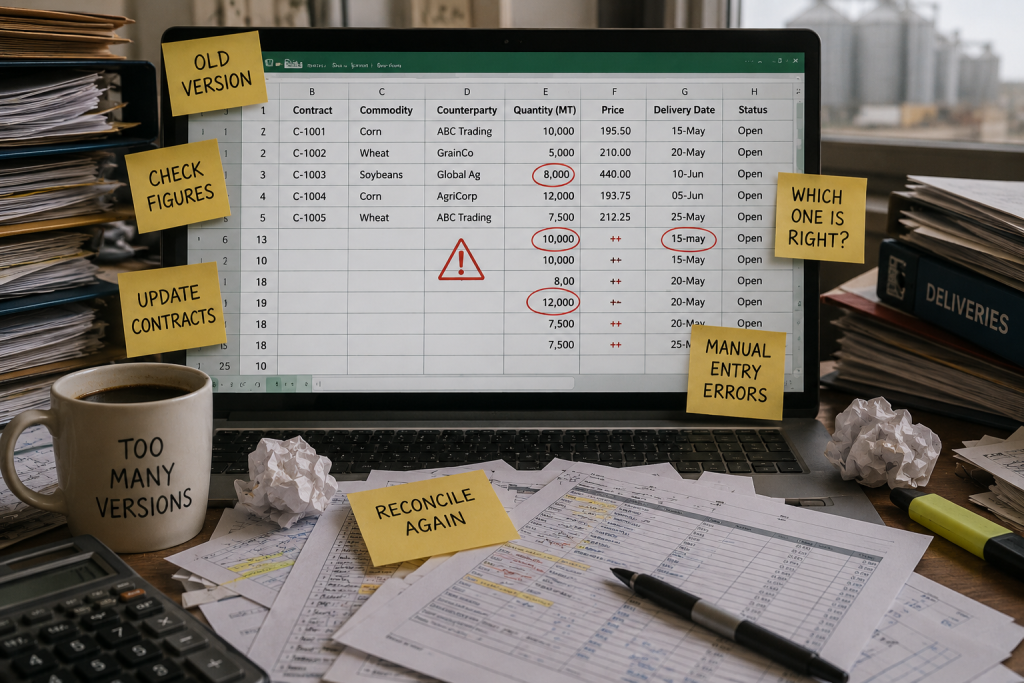
Version control. A reconciliation file shared across a team invites conflicting updates. One trader updates contracts, another updates inventory, a third is still on yesterday’s version. By the end of the day, no one is certain which file reflects reality.
Manual data entry errors. A transposed digit in a tonnage figure. A wrong delivery date. A contract entered twice or not at all. These errors are individually small and collectively devastating, especially given the 94% error rate found across business spreadsheets generally.(1)
No real-time updates. A spreadsheet is a snapshot, accurate only at the moment it was last updated. In an operation where contracts and deliveries are moving all day, a file updated this morning is stale by mid-morning. Reconciling against stale data is not reconciliation. It is a guess.
Disconnected data sources. Contract systems, inventory systems, logistics platforms, and invoicing systems all hold separate pieces of the picture. Pulling them together manually introduces delay at every step and risk at every handoff.
No audit trail. When something goes wrong, tracing what happened and when is nearly impossible. Cells get overwritten, formulas break, and previous versions disappear, so the same mistake tends to repeat.
The Commercial Cost of Getting It Wrong
A position built on unreconciled data leads to decisions made on bad information. A trader who believes they are covered on a forward sale, when the coverage figure is actually wrong, may not discover the shortfall until the delivery window is open and grain has to be sourced at whatever price the market is offering.
For elevator operators, a reconciliation file that misrepresents inbound and outbound commitments can mean overcommitted storage, missed dispatch obligations, or a blown delivery deadline. For operations managers coordinating procurement, storage, logistics, and finance, the absence of one trusted source of truth turns every cross-functional conversation into a debate about whose numbers are right, time spent on the tool instead of the grain.
What Good Commodity Trade Reconciliation Looks Like
The fix is not a better spreadsheet. It is a system where reconciliation happens automatically and continuously, not periodically and manually.
In a digital position reporting and reconciliation system, contracts entered into the platform update the position immediately. Inventory movements at the site update stock figures immediately. Invoices match against delivery records without manual intervention. One source of truth stays consistent across every team. A full audit trail makes every change traceable. And discrepancy alerts flag mismatches before they compound.
Reconciliation stops being a daily chore and becomes a continuous operational control. The business always knows where it stands, decisions are made on current data, and the risk of a reconciliation error turning into a commercial problem drops sharply.
How AgriChain Solves the Reconciliation Problem
AgriChain’s Position Reporting feature is built to eliminate the reconciliation failures spreadsheets create. Positions sync automatically from existing AgriChain contracts and stocks, with no manual extraction, no version control problem, and no double entry. Every contract executed, every delivery confirmed, and every inventory movement updates the position in real time.
For traders, that means decisions made on data that reflects right now, not several hours ago, for elevator operators, it means knowing exactly what is coming in and going out across every site without reconciling disconnected systems. For operations managers, it means every team works from the same numbers, always.
Want to see it in action? Request a demo and we will show you how AgriChain’s Position Reporting works for your specific operation.
Conclusion
Commodity trade reconciliation is too important to leave to a tool that fails 94% of the time. For grain traders, elevator operators, and operations managers handling meaningful volume, the cost of spreadsheet-based reconciliation goes well beyond the time it takes to maintain it. It shows up in decisions made on bad data, in shortfalls found too late to fix cheaply, and in teams working from different versions of the truth.
The grain industry is moving toward digital reconciliation tools that remove these failure points entirely. The operations that make the shift gain something spreadsheets have never offered: a single, accurate, always-current view of where they stand.
Frequently Asked Questions (FAQs)
What is commodity trade reconciliation?
Commodity trade reconciliation is the process of matching and verifying all trading activity across contracts, inventory, logistics, and financial records to ensure everything is accurate, consistent, and accounted for.
Why do spreadsheets fail at commodity trade reconciliation?
Spreadsheets were built for individual analysis rather than dynamic, multi-party operational data. They are vulnerable to version conflicts, manual entry errors, disconnected sources, and stale data, and a 2024 study found that 94% of business spreadsheets contain errors that affect decision-making.
When is it still okay to use a spreadsheet for reconciliation?
A very small operation trading a single commodity with few contracts and one storage location can usually manage reconciliation in a spreadsheet without major risk. The risk grows quickly once more commodities, counterparties, or people enter the process.
What is the commercial cost of poor commodity trade reconciliation?
Poor reconciliation leads to decisions made on inaccurate position data, shortfalls discovered too late to cover cheaply, overcommitted storage, missed deadlines, and friction between teams working from inconsistent numbers.
What does good commodity trade reconciliation look like?
It happens automatically and continuously. Contracts, inventory movements, and deliveries update the position in real time, one source of truth stays consistent across teams, and a full audit trail makes errors traceable.
How does AgriChain’s Position Reporting improve commodity trade reconciliation?
AgriChain’s Position Reporting syncs positions automatically from contracts and stocks in real time, removing double entry, version control issues, and disconnected data sources, so every team works from one accurate view at all times.