
The Grain Software Landscape
Choosing grain management software is not only about features.
The right platform also depends on how much implementation it requires, whether it works in the cloud, how easily it can be adapted to your operation, and whether it connects trading, logistics and day-to-day grain workflows.
Trusted by






















Grain Software Comparison
A side-by-side comparison of leading grain management platforms across key cost and compatibility dimensions.
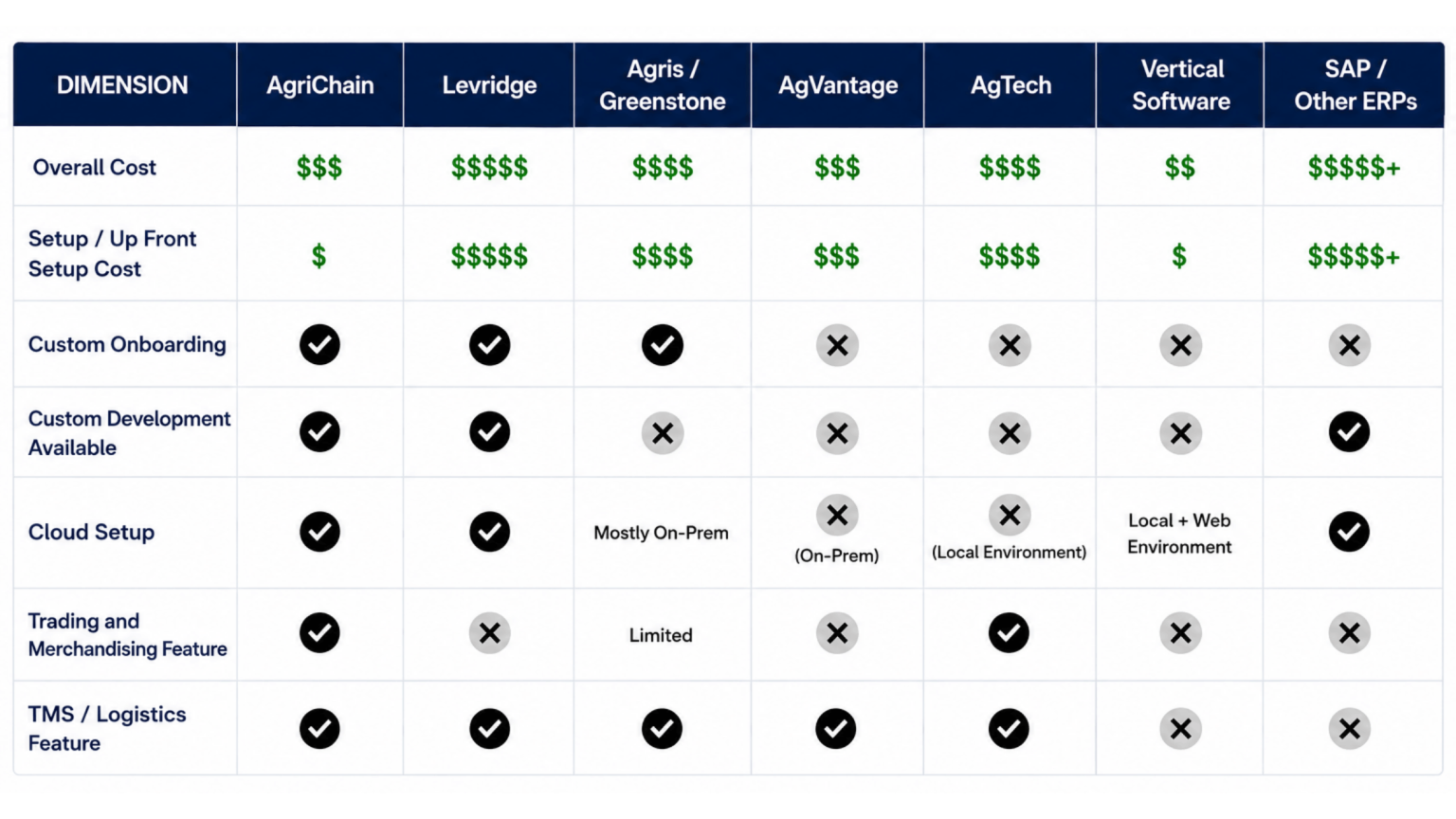
$ = Lower relative cost, $$ = Lower-to-mid relative cost, $$$ = Mid-range relative cost, $$$$ = Higher relative cost, $$$$$ = Very high relative cost, $$$$$+ = Highest relative investment in this comparison
Cost indicators are relative assessments from this comparison and are not published vendor price quotes. Actual pricing can vary according to users, modules, implementation requirements, integrations and commercial agreements.
* Overall ratings are AgriChain’s comparative assessment based on the criteria shown above. They are not independent third-party ratings.
Which platform is best suited to your operation?
Some platforms were built primarily as grain systems. Others are generic ERPs adapted to agriculture. Some provide connected end-to-end workflows, while others rely more heavily on separate modules, hardware or additional systems.
AgriChain
Best for connected, end-to-end grain operations
- Relative Cost: $$$
- Setup Cost: $
- Deployment: Cloud
- End-to-end operational coverage
- Cloud-based deployment
- No specialised hardware required
- Custom onboarding
- Custom development available
- Trading and merchandising functionality
- Logistics and TMS functionality
- Support for multiple supply-chain participants
Best suited to: Grain elevators, cooperatives, traders, processors and agribusinesses looking for an end-to-end cloud platform.
AgriChain combines a relatively moderate ongoing cost with a lower setup cost.
Its cloud architecture also reduces the need for dedicated on-site infrastructure.
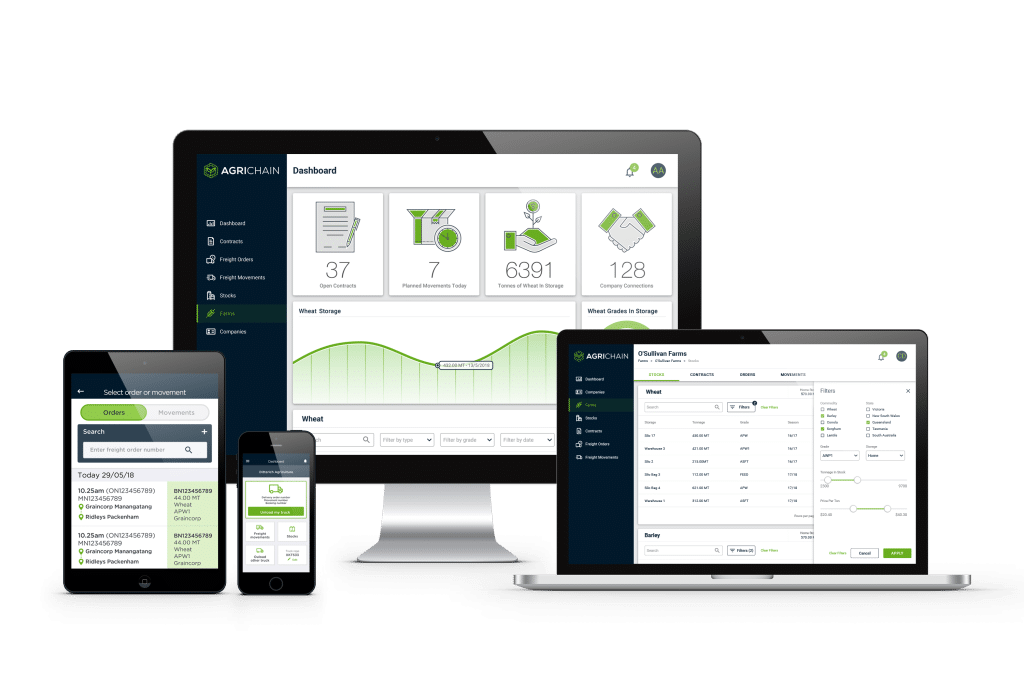
The platform’s main differentiator is the ability to connect operational, trading and logistics workflows across multiple participants rather than treating each area as a separate system.
Levridge
Best for organisations already comfortable with Microsoft Dynamics
- Relative Cost: $$$$$
- Setup Cost: $$$$$
- Deployment: Cloud
- End-to-end operational model
- Cloud-based
- Logistics functionality
- Some custom development available
- Modern ERP foundation
Best suited to: Organisations prepared for a larger ERP investment and comfortable operating within the Microsoft Dynamics ecosystem.
Levridge is one of the newer agricultural systems included in this comparison and offers broad end-to-end functionality.
It is built around Microsoft Dynamics ERP, which is an important consideration when evaluating implementation complexity and total cost.
Levridge has the highest standard cost rating in this comparison alongside a high upfront implementation cost.
Microsoft Dynamics is also required as the underlying ERP environment.
Trading and merchandising are not listed as built-in capabilities in the comparison.
Agris / Greenstone
Best for businesses that prefer an established industry system
- Relative Cost: $$$$
- Setup Cost: $$$$
- Deployment: Primarily on-prem
- Established grain-industry presence
- Logistics functionality
- Some trading and merchandising capabilities
- Customizable onboarding
- Continued product development
Best suited to: Grain organisations looking for an established industry platform and comfortable working with additional modules or integrated systems.
Agris / Greenstone is one of the established grain-management platforms in the market.
The system is primarily on-premise, although newer cloud development is taking place.
Its operational model is more siloed than newer end-to-end systems.
Businesses may also require additional modules or partner systems to cover broader workflows.
Custom development is not listed as available in this comparison, and specific equipment may be required.
AgVantage
Best for businesses looking for a traditional grain-system alternative
- Relative Cost: $$$$
- Setup Cost: $$$$
- Deployment: Primarily on-prem
- Grain-industry focus
- Logistics functionality
- Moderate relative cost
- Established operational approach
Best suited to: Businesses seeking a traditional grain-management system and comfortable maintaining on-premise infrastructure.
AgVantage is another established grain-management system built around a more traditional software model.
AgVantage is on-premise and requires specific hardware.
Its operating model is siloed rather than end-to-end.
Trading and merchandising are not listed as available, and custom development is not included in this comparison.
The size of the vendor team may also be relevant for organisations requiring substantial implementation support or long-term customization.
AgTech
Best for organisations needing both elevator and merchandising capabilities
- Relative Cost: $$$$
- Setup Cost: $$$$
- Deployment: On-prem
- Trading and merchandising capabilities
- Logistics functionality
- Grain elevator functionality
- Broader commodity-management modules
Best suited to:Organisations looking for a combination of traditional grain operations and merchandising functionality.
AgTech combines functionality for grain elevator operations with commodity trading and merchandising capabilities.
The platform is on-premise and may require specific equipment.
Its operational model is categorized as siloed in this comparison, meaning organisations may need to move between modules or systems rather than operating through one fully connected workflow.
Custom development is not listed as available.
Vertical Software
Best for smaller or simpler grain operations
- Relative Cost: $$
- Setup Cost: $
- Deployment: Local + Web
- Lower relative cost
- Low upfront cost
- Suitable for straightforward requirements
- Established grain and scale-management tools
Best suited to: Smaller or single-site operations with relatively straightforward grain-management requirements.
Vertical Software is the lowest-cost specialist grain option in this comparison.
The platform is more limited in scope than the larger systems in this comparison.
Trading and merchandising functionality are not listed.
Logistics and TMS capabilities are also not included.
Specialised equipment may be required, and the operating model remains largely siloed.
These factors may become more important as an organisation grows or adds more complex workflows.
SAP
Best for enterprises already heavily invested in a general ERP
- Relative Cost: $$$$$+
- Setup Cost: $$$$$
- Deployment: Cloud
- Highly customizable
- Enterprise-scale architecture
- Suitable for organisations with significant internal IT resources
- Can integrate agriculture into a broader corporate ERP strategy
Best suited to:Large enterprises already committed to a general ERP environment and prepared for significant customization.
SAP and similar enterprise resource planning systems take a very different approach from purpose-built grain software.
SAP has the highest relative cost rating in this comparison.
Implementation also depends heavily on consultants and custom development.
Trading, merchandising and logistics capabilities are not listed as native grain functionality in this comparison and may require additional development or other systems.
For larger enterprises already committed to SAP or another ERP, the investment may still make sense.
For organisations starting specifically with a grain-management requirement, however, purpose-built platforms can provide a more direct path.
Frequently Asked Questions
What is the difference between end-to-end and siloed grain software?
End-to-end grain software connects multiple areas of the operation within one environment, such as contracts, inventory, movements, trading, logistics and customer workflows.
Siloed systems may still perform important grain-management functions, but businesses may need separate modules, integrations or additional systems to connect different parts of the operation.
The right approach depends on the complexity of your business and how much integration you need.
Is cloud-based grain software better than on-premise software?
Not necessarily. The better option depends on your infrastructure, IT resources and operational requirements.
Cloud-based platforms can reduce reliance on local servers and specialised on-site infrastructure while making system access and updates easier across multiple locations.
On-premise platforms may still suit organisations that already have the required infrastructure or prefer to manage systems locally.
Some platforms also use a mixed approach, combining locally installed software with newer web-based modules.
How much does grain management software cost?
The software licence is only one part of the total cost.
When comparing platforms, consider both ongoing software costs and upfront implementation requirements.
Additional costs may include:
- Hardware
- ERP licences
- Consultants
- Custom development
- Additional modules
- Integrations
- Internal IT resources
- Training
- Change management
A platform with a lower subscription cost may not always have the lowest total cost of ownership.
What should I compare when choosing grain management software?
It depends on how your business operates.
For organisations where merchandising is central to daily operations, it is important to confirm whether those capabilities are included within the platform or require another system.
If trading and merchandising are less important to your business, other factors such as inventory, logistics, deployment and implementation may carry more weight.
Should logistics and TMS functionality be part of the same grain platform?
For businesses managing frequent commodity movements, integrated logistics functionality can reduce the need to move information between separate systems.
When comparing vendors, determine whether transportation and commodity movements can be managed within the platform or whether a separate TMS is required.
The right choice will depend on the volume and complexity of your logistics operation.