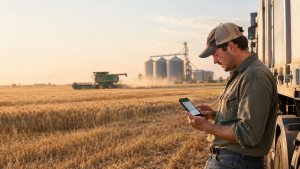

Truck weighing sits at the heart of every grain, bulk commodity, and logistics operation. Every inbound and outbound load affects inventory accuracy, payments, compliance, and ultimately profitability. Yet across many sites in the US, Canada, and Australia, weighbridge processes are still manual, fragmented, and difficult to scale.
Operators rely on spreadsheets, handwritten logs, or disconnected systems to record weights. As truck volumes increase, this approach leads to delays, errors, and limited visibility across operations. What should be a control point often becomes a bottleneck.
The global weighbridge market was valued at $3.56 billion in 2024 and is projected to reach $6.70 billion by 2035 at a CAGR of 6.4%(1), and for businesses still running manual processes, that window to modernize is closing fast.
This is where truck scale software becomes critical for modern agribusinesses.
What Is Truck Scale Software?
Truck scale software is a digital system that manages the process of weighing trucks and capturing weight data in a structured, automated way. It connects weighbridge operations with inventory, contracts, and financial systems to ensure accuracy and consistency, transforming manual recording into a fully integrated operational workflow.
In agricultural and bulk handling environments, this includes:
- Capturing inbound and outbound truck weights
- Linking weights to contracts and deliveries
- Generating digital weighbridge tickets
- Maintaining compliance records
- Sharing real-time data across systems
It turns the weighbridge from a standalone checkpoint into a connected, intelligent part of the supply chain.
Why Manual Truck Weighing Breaks at Scale
In the US alone, trucks are responsible for 83% of all agricultural freight movements by tonnage(2). Even grain, which often travels long distances by rail or barge, still has more than 70% of its volume moved by truck. That is an enormous number of weighbridge transactions happening every day, across thousands of sites.
Manual weighing processes may work at low volumes, but they struggle to keep up as operations grow. What starts as a simple process quickly becomes difficult to manage when truck frequency increases and multiple stakeholders are involved.
The core problem is data quality. Manual tracking in supply chain and logistics operations results in errors in 3 to 5% of transactions, with those errors consuming 25 to 35% of administrative time just to correct(3). In a high-frequency weighbridge environment, that error rate compounds quickly into real financial losses, including disputes with suppliers, incorrect inventory records, and missed compliance requirements.
Delays at the weighbridge slow down truck turnaround and impact site productivity. Limited visibility makes it harder for teams to coordinate across procurement, logistics, and finance.
As operations scale, manual weighing creates more risk than control.
Key Features of Truck Scale Software
Truck scale software improves accuracy, speed, and coordination across weighbridge operations by automating key processes and connecting them to broader business systems.
1. Automated Weighbridge Operations
Modern systems capture truck weights automatically using integrations with physical weighbridges and sensors. This reduces manual intervention and ensures consistent accuracy across every transaction.
2. Real-Time Data Capture
Weight data is recorded instantly and made available across connected platforms. This allows teams to act on up-to-date information instead of relying on delayed or manually updated records.
3. Integration Across Business Systems
Truck scale software connects with inventory, contracts, and logistics platforms to ensure seamless data flow. This eliminates duplication and improves coordination between operational and financial teams.
4. Digital Ticketing and Records
Weighbridge tickets are generated digitally and stored within the system for easy retrieval. This removes paperwork and ensures all transactions are properly documented.
5. Compliance and Audit Tracking
Every transaction is logged with detailed records that support compliance and traceability requirements. In Australia, this is especially critical under the National Heavy Vehicle Regulator’s (NHVR) Chain of Responsibility (CoR) legislation, which holds all parties in the supply chain legally liable for overweight loads and non-compliant weighing practices, not just drivers(4). Truck scale software with built-in audit trails makes demonstrating CoR compliance straightforward and defensible.
6. Role-Based Access Control
Access to weighing data is managed based on user roles within the organisation. This protects sensitive information while maintaining operational transparency.
Benefits of Truck Scale Software
Adopting truck scale software leads to measurable improvements in efficiency, accuracy, and visibility. These benefits become increasingly important as truck volumes grow and operations become more complex.
Faster Truck Turnaround
Automated weighing reduces waiting times at the weighbridge and improves truck flow. This increases throughput and helps sites handle peak volumes more efficiently.
Reduced Errors and Disputes
Removing manual data entry improves accuracy across all transactions. This reduces the likelihood of disputes with suppliers, transporters, and internal teams.
Improved Operational Visibility
Real-time access to weighing data provides a clear view of truck movements and site activity. This enables faster decisions and better coordination across teams.
Stronger Inventory Accuracy
Accurate weight capture ensures inventory reflects actual physical movement. This improves planning, reporting, and financial reconciliation.
Scalable Operations
Truck scale software supports increasing volumes without adding operational complexity. This allows businesses to expand across sites while maintaining consistency.
How to Choose the Right Truck Scale Software
Selecting the right truck scale software requires careful evaluation of your operational needs and future plans. The right platform should improve efficiency today while supporting growth tomorrow.
Ease of use
The system should be intuitive for operators and require minimal training. A simple interface ensures faster adoption and reduces operational errors.
Integration capabilities
The software must connect with ERP, inventory, and logistics systems to ensure smooth data flow. This reduces manual reconciliation and improves coordination across teams.
Level of automation
Look for solutions that minimise manual input throughout the weighing process. Higher automation improves accuracy and reduces dependency on individual operators.
Scalability
The platform should handle increasing truck volumes and multiple sites without performance issues. This ensures long-term reliability as your business grows.
Implementation and support
Strong onboarding and ongoing support are essential for successful adoption. Reliable vendor assistance ensures issues are resolved quickly and operations continue without disruption.
Truck Scale Software in a Connected Supply Chain
Weighbridge operations do not function in isolation. They are closely linked to procurement, logistics, inventory, and financial systems across the business. When these systems are disconnected, inefficiencies and data gaps become difficult to manage.
Truck scale software bridges this gap by integrating weighing data with the broader supply chain. This ensures that every load is accurately tracked from arrival to delivery and settlement. As a result, weighbridge operations become a key driver of operational efficiency rather than a point of friction.
A Market Moving Toward Automation, Especially in North America
For US and Canadian agribusinesses, the shift to automated weighbridge software is already underway. The Agriculture and Farming truck scale segment in the US is projected to grow at a 4.7% CAGR through 2032(5), driven by rising demand for precision compliance and integrated operations.
Canada is growing even faster. The Canadian truck scale market is expanding at a 6.1% CAGR from 2025 to 2032, the strongest rate in North America(5), as agricultural operations invest in digital weighbridge infrastructure to handle growing volumes and tighter compliance requirements.
In Australia, the pressure is equally real. Grain harvests have risen from around 20 million metric tonnes in the 1980s to a range of 55 to 70 MMT in recent years, a threefold increase that has fundamentally stretched the capability of storage and logistics networks(6). Manual weighbridge processes are difficult to sustain at that scale.
Why AgriChain AutoWeigh for Trucks?
For agribusinesses managing high truck volumes, weighbridge efficiency is critical to overall performance. AgriChain’s AutoWeigh solution is built specifically for agricultural supply chains and integrates seamlessly with contracts, inventory, and logistics systems. This ensures that weighing is accurate, fast, and fully connected to business operations.
- Automated truck weighing reduces manual effort and improves consistency across sites
- Real-time integration ensures weight data flows directly into operational and financial systems
- Faster processing reduces congestion and improves truck turnaround times
- Accurate data capture supports compliance and reduces disputes
- Scalable architecture supports multi-site operations across regions
With AutoWeigh, weighbridges move from operational bottlenecks to high-efficiency control points within the supply chain.
From Bottleneck to Control Point
Truck weighing plays a critical role in ensuring accuracy, efficiency, and accountability across supply chains. As operations grow, manual processes become harder to manage and introduce unnecessary risk. Businesses that continue relying on outdated methods face delays, compounding errors, and a compliance environment that is only getting stricter.
The market data points in one direction. A global weighbridge industry projected to nearly double by 2035. North American agriculture truck scale segments growing at 4.7 to 6.1% annually. Manual error rates eating into margins that most operations cannot afford to lose.
Truck scale software provides a clear path forward. It improves accuracy, speeds up operations, and connects weighbridge activity to the broader business ecosystem. If you are still relying on manual truck weighing, upgrading to a connected software solution is a necessary step toward building a more efficient, compliant, and scalable operation.
Sources
- https://www.marketresearchfuture.com/reports/weighbridge-market-28115
- https://www.ttnews.com/articles/trucks-key-movement-agricultural-products-usda-report-finds
- https://www.isoprosoftware.com/blog-2025-04-28-manual-versus-software-based-compliance.html
- https://www.nhvr.gov.au/safety-accreditation-compliance/chain-of-responsibility
- https://www.researchandmarkets.com/report/north-america-truck-scale-market
- https://onlinelibrary.wiley.com/doi/10.1111/1467-8489.70029