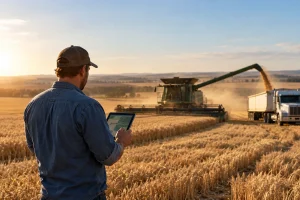
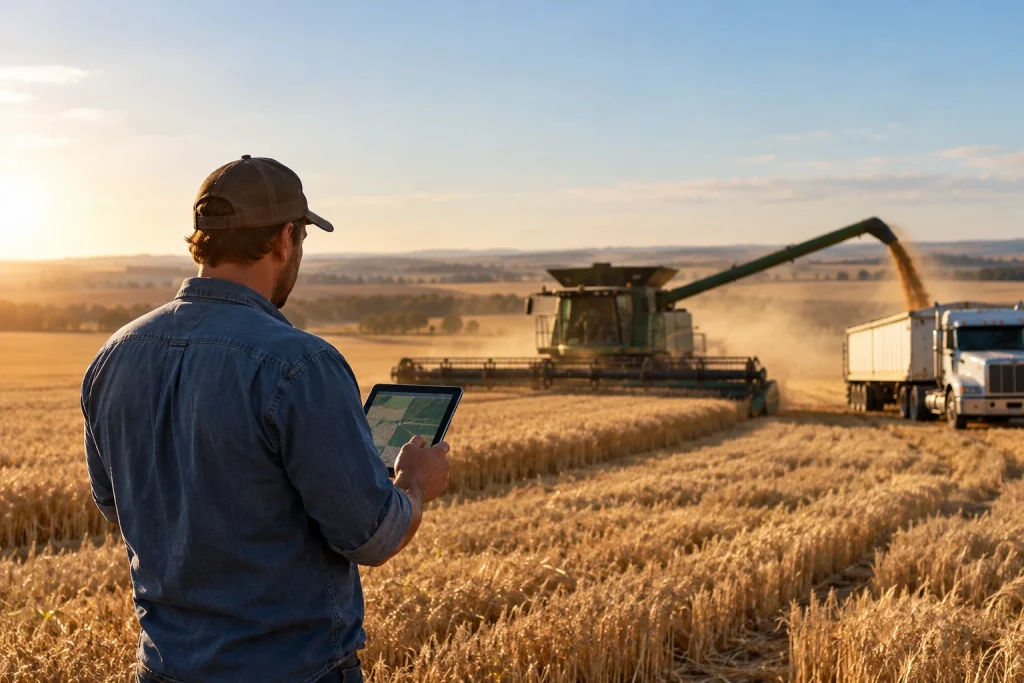
Agtech, short for agricultural technology, is any technology used to grow, store, move, or sell crops and livestock. It includes GPS-guided tractors, soil sensors, drones, farm software, and platforms that track grain from the field to the buyer.
Most guides stop at the farm gate. This one also covers what happens after harvest. It shows how adoption looks in the United States, Canada, and Australia.
Key takeaways
- Agtech is any technology used to grow, store, move, or sell crops and livestock.
- The main types are precision agriculture, farm software, sensors, drones, robotics, biotech, supply chain software, and marketplaces.
- Adoption is higher on larger farms in the US and Canada. Cost is the main barrier in Australia.
- A lot of value sits after the farm gate, in weights, contracts, freight, and invoices.
What is agtech?
Agtech is the use of technology to make agriculture more productive, efficient, and traceable. You will also see it written as “ag tech” or “AgTech.” All three mean the same thing as agricultural technology.
It covers three broad areas. On-farm tools help growers plant, spray, and harvest with more precision. Data tools turn records, sensors, and imagery into decisions. Supply chain tools manage grain, contracts, freight, and payments once the crop leaves the field.
These areas overlap. A yield monitor creates data. Farm software stores it. A supply chain platform links it to a contract and a delivery.
Why do definitions of agtech differ?
Definitions of agtech vary. In 2018, the United States Studies Centre defined it as products and services that contain or are enabled by patented technology in the agriculture value chain. It leaves out consumer-facing items such as meal kits.(1) The Queensland Government defines it as any innovation used across the agribusiness value chain to improve efficiency, profitability, sustainability, and credibility. Its list covers hardware and software, robotics and sensors, and non-digital items such as protected cropping structures, packaging, machinery, and biotechnology.(2)
This guide uses the broad view, because supply chain tools matter as much as field tools. It also explains why market size figures differ so much, as shown below.
How is agtech different from related terms?
- Precision agriculture is the use of GPS, sensors, and field data to apply inputs and run machines accurately. It is one part of agtech.
- Digital agriculture is the wider use of digital tools in farming. It overlaps heavily with agtech.
- Agribusiness software is software that companies across the agricultural value chain use to manage operations. It is one category of agtech.
- Agrifoodtech is the term investors use. It is wider than agtech and includes food delivery and e-grocery.
How has agtech changed over time?
Early farm technology was about machines. Agtech today is about data.
GPS-guided steering shows the shift. USDA researchers found auto-steer on only 5.3% of planted US corn acres in 2001. By 2016, that figure was 58%. By 2019, GPS applications were used on 40% of all US farm and ranchland acreage.(3)
Yield monitors, soil maps, and variable-rate tools followed. Drones, sensors, and farm software are now common. The current focus is connecting these tools, so data moves from the field to the contract, the truck, and the invoice.
How big is agtech?
Investors track the sector as agrifoodtech. Global agrifoodtech funding reached $16.2 billion in 2025, down 3% from the prior year.(4) Upstream startups, which build technology for farms, food production, and biological systems, drew $9 billion. That is up 7%, even as global deal count fell 12%.(4)
The largest deal of 2025 was 80% smaller than the sector’s peak deal in 2021, as growth-at-all-costs funding for food delivery and eGrocery faded.(4) The money is getting pickier. Investors are favoring companies with tangible science, real unit economics, and clear paths to revenue.(4) For buyers, that favors vendors who can show results.
Market size estimates vary because definitions vary. The Business Research Company puts the global agtech market at $26.02 billion in 2025, rising to $30.15 billion in 2026.(5) Ken Research, which uses the term agritech, puts the 2025 market at about $31 billion.(6) Check what a report counts before you compare numbers.
What are the main types of agtech?
| Type | What it does | Examples |
|---|---|---|
| Precision agriculture | Uses GPS and field data to apply inputs and run machines accurately | Autosteer, yield monitors, variable-rate sprayers |
| Farm management software | Records field activity, inputs, and costs | Crop planning, spray records, field logs |
| Sensors and IoT | Measure conditions in soil, crops, animals, and storage | Soil moisture probes, grain bin monitors, livestock tags |
| Drones and satellite imagery | Capture images to spot crop stress, weeds, and variation | Drone spraying, crop health maps |
| Robotics and automation | Replace or assist manual work | Robotic milking, autonomous equipment |
| Biotech and biologicals | Improve seeds, crop protection, and soil health | Improved crop varieties, biological inputs |
| Supply chain software | Manages grain and commodity movement after harvest | Receivals, stock, contracts, freight, invoicing |
| Marketplaces and fintech | Connect buyers and sellers and handle payments | Online trading platforms, digital payments |
Most businesses use several types together. A few notes on how they perform in practice:
- Precision agriculture is often the first step. Guidance systems and yield monitors are among the most widely used tools.(9)
- Farm management software is the most widely used type among Australian farmers. Roy Morgan found it leads all other forms of agtech in its 2024 survey.(7)
- Drones are still a small share of use. In Canada, 3.6% of farms reported drone technology in 2020.(8)
- Robotics has one clear success story. Among Canadian dairy farms, 20.2% reported robotic milkers in 2020, up from 8.9% in 2015.(8)
- Supply chain software works after the farm gate, where grain changes hands. That is covered in its own section below.
How does agtech work in practice?
Picture one harvest day on a grain farm.
An autosteer tractor and combine run straight, evenly spaced passes. A yield monitor logs how much each part of the field produces. At the end of the day, the grower opens farm software and sees yield by field.
Trucks then carry the grain to a storage site. A weighbridge records each load. Staff test quality and match the load to a contract. Freight is booked. An invoice follows.
Each step uses a different type of agtech. The value comes when the steps share data. Without shared data, the weight sits in one system, the contract in another, and the invoice in a third. Someone has to match them by hand. Errors surface days later, when a payment does not match a delivery.
How are farms adopting agtech in the US, Canada, and Australia?
Adoption differs by country, farm size, and technology. Each country measures it differently, so the numbers below are not directly comparable.
United States
In 2023, GPS autosteer ran on 52% of midsize US farms and 70% of large-scale crop-producing farms. Yield monitors, yield maps, and soil maps were used on 68% of large-scale crop-producing farms. Adoption rises sharply with farm size. Small family farms, those with under $350,000 in gross cash farm income, had the lowest rates in every technology group. Among small family farms, the lowest levels were on farms run by retired operators and farms with sales under $150,000.(9)
An earlier ERS study of six major crops shows the same pattern. At least half of larger row crop farms used yield maps, soil maps, variable-rate tools, or guidance systems. Except for cotton, fewer than 25% of smaller farms used any of those four. The study’s authors suggest this may be because the returns from technology are greater on larger farms. (3)
Canada
In the 2021 Census of Agriculture, 95,713 farms reported using at least one type of technology in 2020. That is 50.4% of Canadian farms. Soil sample testing was the most common, followed by auto-steer and slow-release fertilizer.(8)
| Technology | Share of Canadian farms, 2020 |
|---|---|
| Soil sample testing | 32.0% |
| Auto-steer | 26.8% |
| Slow-release fertilizer | 23.4% |
| Variable-rate input application | 16.1% |
| GIS mapping | 13.2% |
| Drones | 3.6% |
| Robotic milkers | 1.2% |
| Robotic greenhouse equipment | 0.2% |
(Statistics Canada, 2021 Census of Agriculture)(8)
Size matters in Canada too. In 2020, 86.9% of farms in the $1 million to $1.99 million revenue class reported at least one type of technology. In the $1 to $9,999 class, the share was 20.6%.(8)
Auto-steer use rose from 20.5% of farms in 2015 to 26.8% in 2020. GIS mapping rose from 8.2% to 13.2%. Saskatchewan had the highest auto-steer rate at 47.6%. Statistics Canada ties this to the province’s large number of oilseed and grain farms.(8)
Australia
A Roy Morgan survey of 1,001 Australian farmers, run in April and May 2024, found that 89% had used agtech or would consider using it.(7) The sample covered cropping, beef, sheep, horticulture, and dairy farmers.(11)
78% had used agtech now or in the past, and 72% were using it at the time of the survey. That is a gap of only 6 points. Few farmers who try agtech give it up.(10)
The upside is large. The Australian Farm Institute estimates that digital technologies could raise the gross value of Australian production by more than $20 billion a year, according to the Queensland Government.(2)
In the US and Canada, larger operations adopt first. In Australia, cost is the main brake, and in all three, interest is high. The gap is cost, fit, and proof of return.
What does agtech do after the farm gate?
Agtech also covers the supply chain after harvest. This is where grain changes hands, so it is where weights, quality results, contracts, freight, and invoices all meet. Grain handlers, storage operators, traders, brokers, and logistics firms deal with all five. Many still rely partly on spreadsheets, paper dockets, and email.
Supply chain agtech does five main jobs:
- Records each load once, at the gate. Weight, grade, and owner are captured as the truck is received, not typed in later.
- Tracks stock across sites and owners. Managers see what they hold, where it sits, and who it belongs to.
- Links loads to contracts and open positions. Each delivery counts against the right contract, so traders know what is delivered and what is still open.
- Books and tracks freight. Trucks, time slots, and deliveries sit in the same record as the load.
- Produces invoices and traceability records from the same data. The invoice follows the delivery without retyping, and the record of where grain came from stays complete.
Different roles use these jobs differently. A grower checks deliveries and stored grain. A storage operator runs receivals and reports stock to owners. A trader manages contracts and counterparties. A logistics provider schedules loads and proves deliveries. A processor sources grain and traces it to origin.
For a deeper look at this category, see our guide to agribusiness software.
What are the benefits of agtech?
- Less manual work and fewer repeated entries. Data is captured once and reused.
- Better use of inputs such as seed, fertilizer, and fuel. Precision tools apply inputs where they are needed.
- Faster decisions from live data. Managers stop waiting for end-of-week reports.
- Easier traceability and compliance reporting. Records are complete and searchable.
- Fewer disputes over weights, grades, and payments. Everyone works from the same record.
Farmers’ own reasons point the same way. In the USDA survey, the most common reasons for adopting precision tools were higher yields, saved labor time, lower input costs, less operator fatigue, and better soil or environmental results. (9)
There is also a paradox. Roy Morgan found that although high cost is a barrier, cost savings are one of the main benefits for farmers who adopt.(10)
What holds agtech adoption back?
- Cost. 66% of Australian farmers in the Roy Morgan survey named price as a hindrance. That is almost double any other reason given.(10)
- Knowledge. 37% said they do not know enough about agtech and what it can do.(11)
- Connectivity. 36% named poor internet and phone coverage.(11)
- Perceived need. 23% said they had no need for agtech, and 19% saw only a low benefit.(11)
- Skills and time. New tools take training, and harvest leaves little spare time.
- Tools that do not share data. Separate systems create more retyping, not less.
- Unclear data ownership. Growers and businesses want to know who holds their records.
What are the agtech trends to watch in 2026?
Investors favor proven revenue. Debt financing reached 18.2% of total agrifood funding in 2025, its highest share in a decade. AgFunder News notes this could signal distress, but it also suggests some companies now have revenue profiles that debt investors can underwrite.(12)
Deeptech is gaining share. Deeptech’s share of agrifoodtech deals climbed from 22% to 32% over the past decade.(12)
New companies are getting funded. The share of deals going to first-time-funded companies rose to 46% in 2025, after years of decline.(12)
Farm robotics holds steady. Deal activity in farm robotics held steady while almost every other category’s deal count fell.(12)
For buyers, the practical takeaway is to ask vendors for customer results and revenue stability, not only features. (Source: AgFunder Global AgriFoodTech Investment Report 2026)
How do you choose agtech?
- Start with one problem. Name the task that wastes the most time or money. Ask: what would success look like in numbers?
- Check that it works where you work. Ask whether it runs offline and syncs later. Poor coverage is a real barrier.
- Ask about integrations by name. Confirm which systems it connects to today, and whether data flows both ways.
- Confirm local support. Rules, units, and support hours differ across countries. Ask who supports you in your time zone.
- Test it on one site or field first. Judge it on a real season, not a demo.
- Check data export. You should be able to take your records with you.
Want to see how this works for grain? Book a demo.
Where does AgriChain fit in agtech?
AgriChain is an agricultural supply chain management platform. It covers the post-harvest side of agtech and connects growers, storage operators, traders, brokers, logistics providers, and processors on one system. It operates in Australia, the US, and Canada.
The platform includes AutoWeigh for trucks, digital contracting, bulk inventory management, timeslotting and procurement, freight management, warehouse fees, digital declarations, container packing, invoicing and payments, and position reporting. Teams use web and mobile apps. AgriChain is SOC 2 Type 1 certified.
Explore the solutions for storage operators, growers and producers, and grain traders.
Frequently Asked About ‘AgTech’ (FAQs)
What is agtech?
Agtech, short for agricultural technology, is any technology used to grow, store, move, or sell crops and livestock. It includes precision equipment, sensors, drones, farm software, and supply chain platforms.
What are examples of agtech?
Common examples are GPS autosteer, yield monitors, soil sensors, drones, robotic milking, farm management software, and grain supply chain platforms.
What is the difference between agtech and precision agriculture?
Precision agriculture is one part of agtech. It uses GPS, sensors, and field data to apply inputs and run machines accurately. Agtech also includes software, biotech, robotics, and supply chain tools.
Is agtech the same as agribusiness software?
No. Agribusiness software is one category of agtech. It covers the software that agricultural companies use to manage stock, contracts, freight, and payments.
What is agtech used for after harvest?
It is used to record weights and quality, track stock across sites, manage contracts, book freight, and issue invoices. It also keeps the records needed for traceability.
How big is the agtech market?
Estimates vary by how each report defines agtech. For 2025, published figures range from about $26 billion to about $31 billion.(5) (6)
Sources
- What is AgTech?
- About AgTech
- Precision Agriculture in the Digital Era: Recent Adoption on U.S. Farms
- AgFunder Global AgriFoodTech Investment Report 2026
- Agtech Market Report 2026
- Global Agritech Market Size, Share & Forecast, By Product Type, Crop Type & Application, 2026-2031
- AgTech is used by a majority of Australian farmers with John Deere, Gallagher and Elders the top AgTech brands
- Canada’s farms integrate renewable energy production and technologies toward a future of sustainable and efficient agriculture
- Precision agriculture use increases with farm size and varies widely by technology
- The brands Australian farmers think of when it comes to agtech revealed
- Pollster’s survey gives insights into farm agtech use
- New report: Agrifoodtech funding is flat but the story is shifting