Grain businesses manage far more than financial records. They deal with contracts, inventory, storage, logistics, and settlements at the same time.
That complexity is one reason the global grain trade has grown into a massive industry. According to the FAO, the world produces over 2.8 billion tonnes of grain every year, creating huge volumes of transactions to manage.
For grain elevators, traders, and processors, every load of grain affects both inventory and finance. A single delivery can trigger contract updates, inventory adjustments, pricing calculations, and supplier payments.
Many grain companies still manage these processes with spreadsheets, legacy systems, and general accounting tools. But these tools were never designed for the operational complexity of grain supply chains.
As grain markets grow more global and data-driven, the limitations of these systems become clearer. Grain accounting software helps businesses track financial records and physical grain movements together.
The History of Accounting in the Grain Industry
Grain accounting didn’t start with software. It started with simple ledgers.
By the 1800s, grain trading was expanding rapidly across North America. Merchants, elevators, and traders recorded deliveries, sales, and storage in handwritten books.
Grain elevators also needed to track physical inventory. This meant accountants were managing both money and grain movements long before digital systems existed.
By the mid-20th century, grain companies began using early computer systems. These replaced paper ledgers but still focused mainly on accounting.
They rarely handled operational details like grading, freight, or contract settlements. As a result, spreadsheets became common alongside accounting systems.
Over time, specialized grain accounting systems began to appear. These systems connected financial records with physical grain movements.
What Is Grain Accounting Software?
Grain accounting software is designed specifically for grain businesses. It manages both financial records and physical grain movements in one system.
Traditional accounting tools focus mainly on money. Grain companies also need to manage contracts, inventory, settlements, and logistics.
Every load of grain affects both inventory and finance. Grain accounting software connects these two sides automatically.
For example, when a farmer delivers grain, the system records weight, grade, ownership, storage, and payment details. These transactions happen simultaneously in modern systems.
This level of complexity is common in grain operations. In the United States alone, there are more than 8,000 grain elevators handling millions of deliveries each year.
Managing these transactions manually quickly becomes inefficient. Software helps automate processes and reduce errors.
Modern grain accounting systems also support accounting methods used in agribusiness. These include accrual accounting, contract accounting, and inventory valuation.
Another key feature is settlement management. Grain companies often calculate payments using weight, grade adjustments, freight costs, and contract terms.
Doing this manually can take hours. Software automates these calculations and improves accuracy.
Grain Accounting Systems Used Today
Many grain businesses still rely on a combination of systems. These systems have evolved as operations became more complex.
Some smaller grain companies still use general accounting software. Tools like QuickBooks help manage financial records but rarely handle grain operations.
Because of this, spreadsheets became a common solution. Many businesses built their own tracking systems using Excel.
Spreadsheets can work at small scale. But they become difficult to manage as grain volumes grow.
Data often ends up scattered across multiple files. This increases the risk of errors and slows reporting.
Some grain companies also use custom-built systems. These systems are designed internally to support specific operational processes.
Custom systems can solve certain problems. But they are often expensive to maintain and difficult to update.
Over the past two decades, specialized grain accounting systems have become more common. These platforms combine accounting, contract tracking, and inventory management.
Modern systems also integrate with other tools used across the grain supply chain. These may include scale systems, logistics platforms, and trading software.
How Grain Finance Works
Grain finance is different from traditional business finance. Money and grain move together in every transaction.
Most grain businesses operate through contracts. These contracts define price, quantity, delivery period, and payment terms.
A farmer may deliver grain today but receive payment later. This creates financial obligations that must be tracked carefully.
That is why accrual accounting is commonly used in grain businesses. It records revenue and expenses when they are earned rather than when cash moves.
Inventory is another major part of grain finance. Grain stored in elevators represents both a physical asset and a financial value.
The value of this inventory changes constantly. Grain prices can shift daily due to supply, weather, and global demand.
For example, global wheat prices have historically moved 20–40% within a single year during volatile market conditions.
Grain companies also manage settlements. A settlement calculates what a farmer should be paid after accounting for grade, freight, storage, and contract terms.
Even a single delivery can involve several adjustments. That is why software plays a key role in modern grain finance.
How to Choose Grain Accounting Software
Choosing grain accounting software is not just a technology decision. It is an operational decision that affects how the entire business runs.
The first thing to consider is industry fit. The system should be designed specifically for grain businesses.
Grain companies manage contracts, inventory, grading, and settlements daily. Software that understands these processes reduces manual work.
Contract management is another important feature. Grain businesses rely heavily on purchase and sales contracts.
The system should allow companies to track contract positions in real time. This improves visibility and reduces financial risk.
Inventory tracking is equally critical. Grain accounting software should track grain movements across elevators, storage facilities, and shipments.
Accurate inventory visibility also supports financial reporting. It helps companies understand the value of the grain they hold.
Many grain companies now operate across multiple sites. The largest grain traders manage dozens of elevators and storage facilities across regions.
Integration also matters. Accounting systems should connect with scale systems, logistics platforms, and reporting tools.
Finally, the software should scale with the business. Grain operations often expand across locations, commodities, and markets.
Why AgriChain Becomes a Single Source of Truth for Grain Businesses
Many grain businesses struggle with disconnected systems. Operations, logistics, contracts, and finance often live in separate tools.
A connected platform changes that. Here are some ways AgriChain helps create a single source of truth.
1. Connects Operations and Accounting
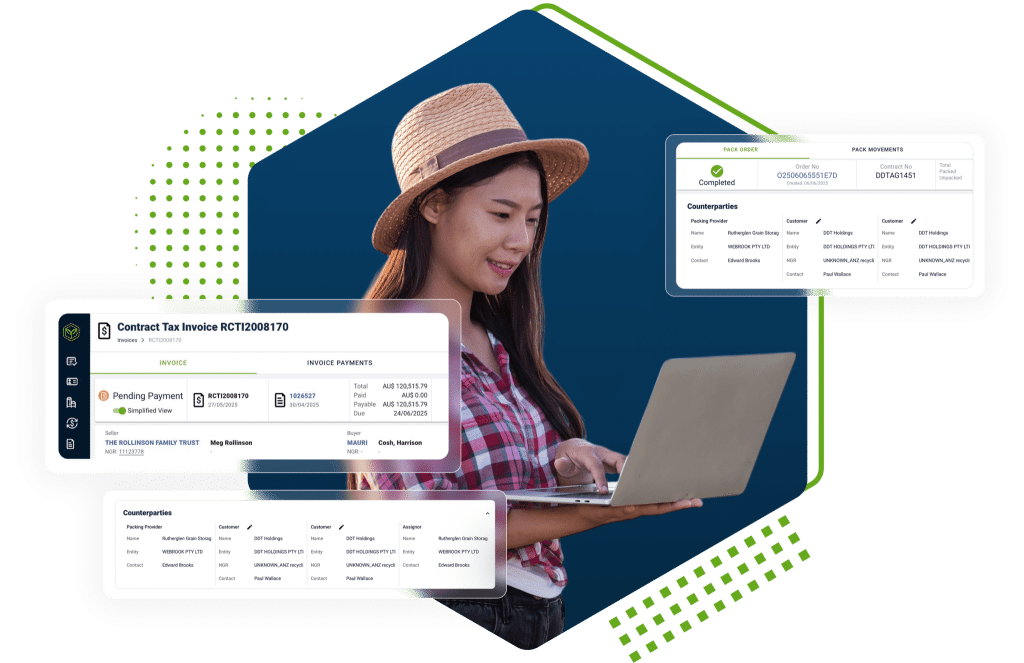
Most accounting systems focus only on financial data. AgriChain connects operational activity with financial records.
Grain movements, contracts, and logistics data flow directly into financial processes. This reduces reconciliation work.
2. Brings the Grain Supply Chain Into One Platform
Grain businesses operate across procurement, storage, logistics, and trading. Managing these processes in different systems creates inefficiencies.
AgriChain connects these activities in a single platform. Teams work with the same operational data.
3. Improves Visibility Across Locations
Many grain companies operate across multiple elevators and trading offices. Without connected systems, visibility becomes difficult.
AgriChain provides operational and financial visibility across locations. Managers can monitor positions and performance from one platform.
4. Reduces Manual Work and Spreadsheets
Spreadsheets remain common in grain operations. They often act as the bridge between disconnected systems.
AgriChain reduces reliance on spreadsheets. Data flows across the platform automatically.
5. Supports Grain Businesses Across Multiple Regions
Grain markets operate globally. Companies often trade across countries and regions.
AgriChain supports grain businesses across Australia, North America, and New Zealand. This allows companies to standardize operations across markets.
6. Creates a Reliable Source of Data
Disconnected systems often create multiple versions of the same data. This makes reporting and decision-making difficult.
AgriChain helps create a shared source of operational and financial information. Teams can work with consistent data across the business.
Conclusion
Grain accounting has evolved significantly over time. What began with handwritten ledgers has grown into sophisticated digital systems.
Today, grain businesses operate in large and complex global supply chains. Billions of tonnes of grain move through these systems every year.
Managing this scale with spreadsheets and disconnected tools is increasingly difficult. Businesses need systems that connect operations, contracts, inventory, and finance.
Grain accounting software helps bring these processes together. It gives companies a clearer view of their grain positions and financial performance.
As the industry continues to evolve, integrated platforms will play a bigger role. Businesses that invest in the right systems today will be better prepared for the future.
Frequency Asked Questions (FAQs)
Grain accounting software is a system designed specifically for grain businesses. It helps manage contracts, grain inventory, settlements, and financial records in one platform.
Unlike general accounting tools, it tracks both physical grain movements and financial transactions together.
Regular accounting focuses mainly on financial transactions. Grain accounting also tracks inventory, contracts, storage, grading, and logistics.
Every grain delivery affects both inventory and financial records. This makes grain accounting more operational than traditional accounting.
Grain businesses handle complex transactions involving contracts, settlements, freight, and storage. General accounting systems are not designed to manage these processes.
Specialized grain accounting software connects operational data with financial records. This helps reduce manual work and improves accuracy.
Good grain accounting software should support:
-Contract management
-Inventory tracking
-Settlement automation
-Integration with scale systems
-Financial reporting
-Logistics and freight tracking
These features help businesses manage both grain operations and finance in one system.
Yes. Most modern grain accounting platforms integrate with systems such as:
1. scale and weighbridge systems
2. logistics platforms
3. trading systems
4. reporting tools
Integration reduces duplicate data entry and improves operational visibility.
Grain accounting software automates tasks such as settlements, contract tracking, and inventory updates. This reduces manual data entry and minimizes errors.
It also provides real-time insights into contracts, inventory positions, and financial performance.
Yes. Grain accounting systems are widely used across major grain markets including North America, Australia, and New Zealand.
As grain supply chains become more global and digital, specialized software has become essential for managing operations efficiently.